The 7-Eleven Liquidity Trap: Why Your Card Fails at 2 AM in Japan
Japanese ATMs accept foreign cards at 7-Eleven and Japan Post only. Here is what to do at 2 AM when your card declines and which networks actually work.
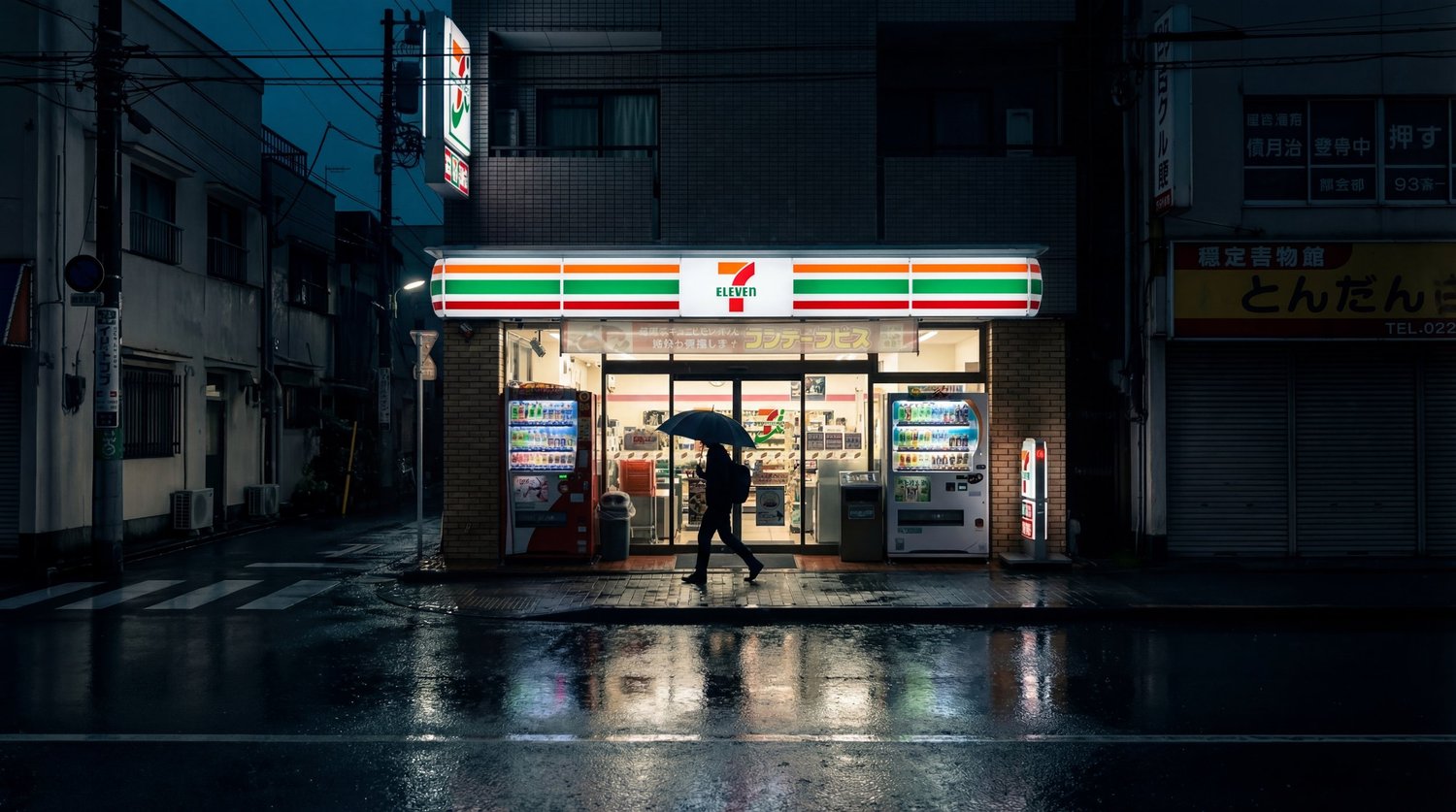
It is 2 AM on a Saturday. You are three whiskeys deep in a Golden Gai bar the size of a closet. The bill comes. Cash only. You stumble to the nearest 7-Eleven, confident that the glowing ATM will solve your problem.
You insert your Bank of America card. You enter your PIN. The screen blinks. “Transaction cannot be completed.”
You have money. You have a valid card. You have done nothing wrong. And yet, you are about to wash dishes.
The Network Gap
Here is the first thing most North Americans do not understand: Japanese ATMs are not universal machines. They are gated communities.
Standard Japanese bank ATMs—Mizuho, MUFG, the regional banks—do not accept foreign cards at all. That sleek machine inside the bank branch? Useless to you. The reliable networks for international cards are Seven Bank (7-Eleven), Japan Post Bank, and the convenience-store machines at Lawson, FamilyMart, and AEON Bank.
But even within the “foreigner-friendly” networks, your card must speak the right language. Canadian Interac cards have zero international presence—they must route through secondary networks like Plus (Visa) or Cirrus (Mastercard) to function. TD Visa Debit cards often get rejected at 7-Eleven but work at Japan Post Bank ATMs – the opposite of what you’d expect. No one knows why. TD offers no explanation.
If your card does not carry the right network logos—Plus, Cirrus, Visa, Mastercard—you are not withdrawing cash in Japan. Full stop.
The Timezone Trap
This is the one that catches people mid-trip.
Your daily ATM withdrawal limit is calculated by your home bank, in your home timezone. Chase resets at midnight Eastern Time. Right now (daylight time) that is 1 PM in Tokyo.
Here is the trap: You withdraw $400 at 8 PM Monday in Tokyo. The next morning—Tuesday in Japan—you try another $400 at 10 AM. But it is only 9 PM Monday in New York. Your bank sees two same-day withdrawals. You have exceeded your limit. Rejected.
Bank Limit Resets (Home Time) Resets in Japan Chase Midnight ET 1:00 PM JST U.S. Bank 4:30 PM CT 7:30 AM JST (next day) Wells Fargo Midnight PT 4:00 PM JST
You did nothing wrong. You simply exist in a timezone your bank does not recognize. And now you are standing in a convenience store at 2 AM, cardless and cashless, trying to explain to a machine that tomorrow already happened.
The PIN Problem
Japan’s payment infrastructure was built for 4-digit PINs. Many North American cards now use 6 digits.
Some Japanese terminals reject 6-digit PINs outright. Some accept only the first four digits. Some fail silently without explanation. The inconsistency is maddening.
If your PIN is longer than four digits, you have three options: change it before you travel, test it immediately upon arrival, or carry a backup card with a 4-digit PIN. There is no fourth option.
The Dynamic Currency Conversion Scam
At some point during your ATM transaction, the screen will ask you a question: “Charge in USD/CAD or JPY?”
This is not a convenience. This is a trap.
Choosing your home currency triggers Dynamic Currency Conversion (DCC)—a service that “locks in” your exchange rate at the ATM. The problem is that the rate includes a hidden markup of 5% to 8%, baked into the conversion rather than displayed as a fee.
On a ¥100,000 withdrawal (~$700 USD):
-
Choose JPY: Your bank converts at near-market rates. Total fees: ~1-3%.
-
Choose USD: The ATM converts at a marked-up rate. Total fees: ~5-8%.
That is $35–56 in hidden costs for pressing the wrong button.
The correct answer is always Japanese Yen. Always. Even if your card charges a 3% foreign transaction fee, you are still paying less than the DCC markup. The only entity that benefits from DCC is the ATM operator.
The Fix
This article has no insurance to sell you. The solutions are purely logistical.
Before you leave:
-
Set a travel notification with your bank—Japan specifically, plus any layover countries.
-
Request a temporary daily limit increase. Standard international limits are often $300–500; ask for $1,000+.
-
Confirm your PIN is 4 digits, or know whether your bank allows the first-four-digits workaround.
-
Download the 7Bank ATM Locator app. Offline access to ATM locations eliminates one variable.
-
Get a local SIM or eSIM before or on arrival so you can locate ATMs and check your bank balance anywhere. Sakura Mobile Voice & Data SIM gives you a Japanese number plus data—useful if you need to verify your Canadian number is still receiving 2FA codes while your data runs through a local plan.
While you are there:
-
Use Seven Bank ATMs at 7-Eleven as your primary. They accept virtually all international cards, operate 24/7, and max out at ¥100,000 (~$700) per transaction.
-
Japan Post Bank is your backup, but hours are restricted (7 AM–11 PM weekdays, shorter on weekends) and the transaction limit is lower (¥50,000).
-
Always decline DCC. Choose Japanese Yen. Every time.
-
Carry two debit cards from different banks, ideally one Visa-network and one Mastercard-network. If one fails, the other might not.
-
Keep $100–200 USD in cash as a last resort. Airport exchange counters exist.
Conclusion
The Japanese ATM system was not designed for you. It was designed for Japanese residents with Japanese bank cards, withdrawing yen during Japanese banking hours. You are a guest in a financial infrastructure that barely acknowledges your existence.
But the system is navigable if you understand its logic. The timezone trap has a workaround: withdraw in the afternoon. The network gap has a solution: use 7-Eleven. The DCC scam has a defense: press the other button.
One more variable worth covering before you travel: if your card gets blocked, your cash gets stolen, or a medical issue interrupts the trip, you want more than a backup debit card. Travel medical insurance via Sacraw covers trip interruption and emergency expenses — worth having in place before your first ATM withdrawal attempt at 2 AM in Shinjuku.
Airalo eSIM — Find the nearest working ATM at 2 AM. Data from landing, no SIM swap. Japan plans from ~$5.
Know the rules. Carry backups. And maybe settle your Golden Gai tab before the third whiskey.